7 Surprising Colors Cats Can (and Can’t) Actually See
When we look at the world, we see a rainbow of rich, vivid colors. But what about cats? Can our feline friends enjoy the same visual experience? While it’s a common myth that cats only see in black and white, science tells a more colorful story—just not the kind we expect.
Contents
Understanding Cat Vision
Cats are crepuscular animals, which means they are most active during dawn and dusk. Their eyes are built for low light conditions. This is why they have excellent night vision, but it comes at a cost: color perception is limited.
The human eye has three types of color receptors, called cones, that allow us to see a wide range of colors. Cats, on the other hand, have only two types of cones. This means they are dichromatic, similar to humans with red-green color blindness.
What Colors Can Cats See
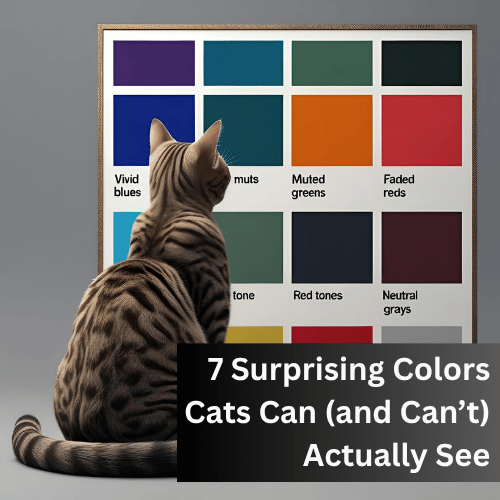
What Colors Can Cats Actually See?
Research in feline vision suggests that cats can see certain colors, but not all. Here’s a breakdown of the colors they perceive:
- Blue – Cats see blue clearly. Shades of blue appear almost the same to them as they do to us.
- Gray – Their vision is well-tuned to various shades of gray, helping them spot movement even in dim light.
- Green – Some greens may be visible, but they are less vibrant.
- Yellow – Yellows likely appear more muted or faded.
- Red – This color is essentially invisible to cats. It likely appears as a dark gray or brown.
- Pink – Often mistaken for another color, pink can seem similar to gray or blue.
- Purple – Purples may be seen as a shade of blue due to overlapping light wavelengths.
Why Cats Don’t Need Full Color Vision
Cats evolved to hunt in low light, not to enjoy the colors of a sunset. Their eyes are more sensitive to motion than to color. This trait is especially useful for stalking prey like mice and birds.
Also, a special layer in their eyes called the tapetum lucidum reflects light, improving night vision. This is why their eyes appear to glow in the dark and why they can detect even the slightest movement in near darkness.
How Cat Color Vision Affects Daily Life
From choosing toys to designing your home, understanding your cat’s color vision can help. Toys in blue or gray tones are more likely to stand out for cats. Red or orange toys might get ignored simply because they blend into the background.
Even food bowls, litter boxes, or bedding might be more appealing in colors cats can recognize more easily. While color isn’t the most important sense for them, making thoughtful choices can enrich their environment.
Common Myths About Cat Vision
Let’s clear up a few misunderstandings:
- Myth: Cats are colorblind.
Truth: They do see color, but not the full spectrum. - Myth: Cats see in total darkness.
Truth: They need some light, but very little. - Myth: Cats see better than humans in all ways.
Truth: Their motion detection and night vision are superior, but their color perception and sharpness are limited.
FAQs
Conclusion
Cats see the world differently than we do, with a unique blend of strengths and limitations. Their vision is perfectly designed for their needs—sharp in low light, sensitive to movement, and tuned to a smaller color range. By understanding what colors cats can and can’t see, we can make smarter choices for their toys, living spaces, and enrichment.
Whether you’re a new cat parent or a lifelong feline fan, knowing how your cat sees can deepen your connection—and make life more colorful for both of you.